Smile
Giant Roman Shoe Unearthed: A Step Back in Time!

Quick Smiles:
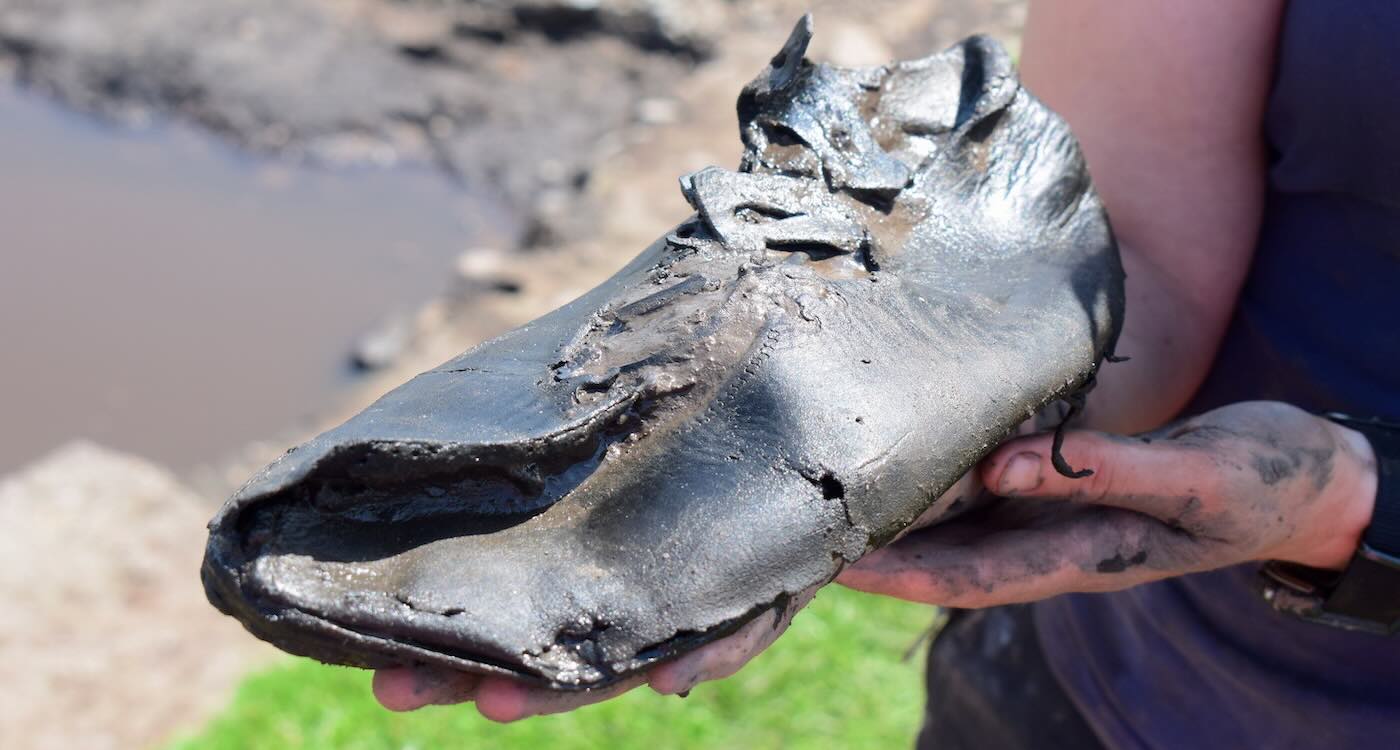
- Archaeologists uncover a massive Roman shoe near Hadrian’s Wall.
- The shoe’s size hints at the stature of the soldier who wore it.
- Numerous shoes, including children’s, suggest soldiers lived with families.
In an extraordinary find, archaeologists have stumbled upon a colossal Roman shoe near Hadrian’s Wall. This discovery was made by a team of resident archaeologists at the Magna Roman Fort in Northumberland.
The leather sole of the shoe stretches an impressive 12.8 inches from toe to heel, indicating it was worn by a remarkably large Roman soldier.
A total of 32 shoes were unearthed from a trench known as the ‘ankle-breaker’ during excavations in May. Among these, eight shoes exceeded 11.8 inches in length, equivalent to a US size 14 or UK size 13. This has left archaeologists pondering the origins of such large footwear.
“We have to assume it’s something to do with the people living here, having bigger feet, being potentially taller but we don’t know,” remarked archaeologist Rachel Frame.
She continued, “Are the people living there from a specific region? Could that be why their shoes are so much larger?”
The shoes were discovered in a shallow defensive ditch, which Romans also utilized as a rubbish dump. Interestingly, the nearby Vindolanda settlement, located seven miles from Magna Fort, has yielded 5,000 shoes since the 1970s. However, only a handful of these shoes measured over 12 inches, suggesting that people in the area were generally smaller.
The shoes’ preservation is attributed to the low oxygen conditions in the soil, which kept the leather in remarkable condition, with soles almost entirely intact, including the treads.
Children’s shoes were also found in the same ditch at Magna Fort, suggesting that these towering Roman soldiers might have lived with their families.
Dr. Elizabeth Greene, Associate Professor at the University of Western Ontario and a shoe specialist, noted, “Even from this small sample uncovered it is clear that these shoes are much larger on average than most of the Vindolanda collection.”
She added, “Although we are comparing this new collection which has not yet gone through the conservation process with the Vindolanda shoes that have, even taking into account a maximum shrinkage of up to 1cm/10mm, it still means these shoes are very large indeed.”
Vindolanda has been a treasure trove for archaeologists over the years. Recently, amateur excavators uncovered a sculpture of the Roman winged goddess of victory at the site.
Located near Hadrian’s Wall, Vindolanda has been an archaeological focus for decades, with only a quarter of the site explored. Currently, teams of professionals and volunteers are diligently working at the site’s infantry barracks.


-

 Cute Animals3 years ago
Puppy Love Patrol: Service Dog Swoons Over K9 Officer Neighbor
-
 Cute Animals3 years ago
Hugs, Hooves, and Happiness: Newborn Donkey Steals Hearts by Demanding Affection [Video]
-

 Cute Animals3 years ago
WATCH: A German Shepherd’s Surprising Parenting Instinct for Lost Ducklings!
-
 Cute Animals3 years ago
Petty Pup Pulls Off Hilarious Bone Heist [Video]
-

 Cute Animals3 years ago
“Pure Love”: Adopted Rescue Dog Can’t Hide How Grateful He Is [Video]
-

 Heroes3 years ago
A Lost Dog’s Bark Leads to a Lifesaving Discovery
-

 Cute Animals3 years ago
Tiny but Mighty: Cat with Dwarfism Becomes Internet Star as Owners Adapt Backyard for Her Comfort
-

 Cute Animals3 years ago
Adorable Puppy Steals Hearts After a Tiring Swim [Video]