Smile
Webb Telescope Spots Ancient, Bright Galaxy

Quick Smiles:
- James Webb confirmed the existence of galaxy MoM-z14, just 280 million years after the Big Bang.
- MoM-z14 defies predictions by being exceptionally bright and chemically complex.
- The discovery offers exciting clues about the universe’s early history and future discoveries.
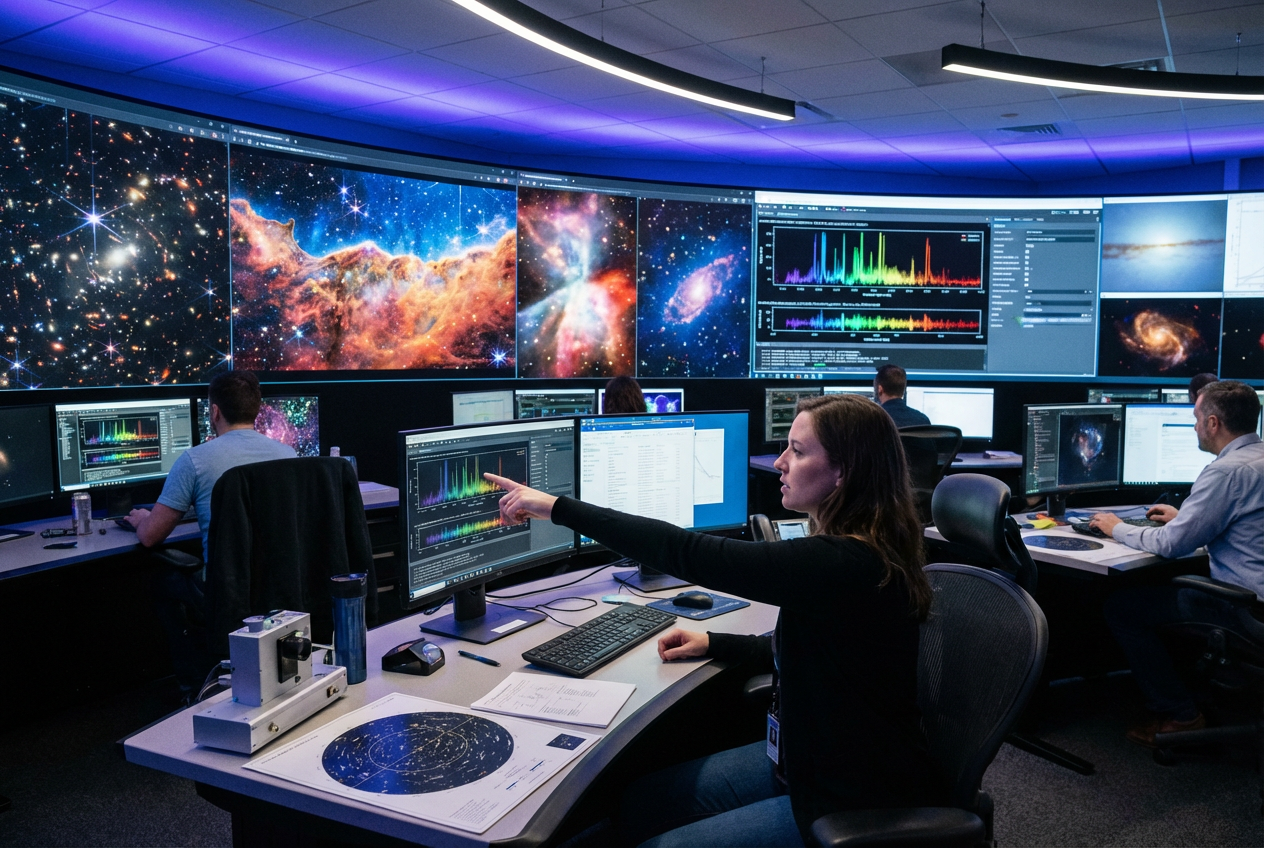
NASA’s James Webb Space Telescope has made another record-breaking discovery, confirming a luminous galaxy called MoM-z14 that dates to only 280 million years after the Big Bang. This galaxy offers astronomers a unique window into the universe’s historical timeline and highlights how different the early universe is compared to expectations.
“With Webb, we are able to see farther than humans ever have before, and it looks nothing like what we predicted, which is both challenging and exciting,” said Rohan Naidu of MIT and lead author of a study on MoM-z14.
Using Webb’s powerful NIRSpec instrument, scientists detected that MoM-z14’s light has been traveling through expanding space for about 13.5 billion years, nearly reaching back to the dawn of the universe. This research adds to the growing list of ancient, surprisingly bright galaxies observed by Webb.
“We can estimate the distance of galaxies from images, but it’s really important to follow up and confirm with more detailed spectroscopy so that we know exactly what we are seeing, and when,” explained Pascal Oesch of the University of Geneva.
MoM-z14 and similar galaxies are much brighter and more chemically enriched than theorized, deepening the mystery of the early cosmos. “There is a growing chasm between theory and observation related to the early universe, which presents compelling questions to be explored going forward,” said Jacob Shen of MIT.
Some features in MoM-z14, such as unusual nitrogen enrichment, are also found in ancient stars in our own galaxy. “It turns out we are seeing some of the same features, like this unusual nitrogen enrichment,” said Naidu.
Since the early universe did not have time for many generations of stars to enrich galaxies with nitrogen, researchers suspect that massive, early stars produced these signatures much faster than expected. MoM-z14 also appears to be helping clear away the thick hydrogen fog left over from the Big Bang, providing a clue about an era called reionization, when light from the first stars changed the cosmos forever.
As discoveries like MoM-z14 accumulate, astronomers look forward to even more breakthroughs with future telescopes, such as NASA’s Nancy Grace Roman Space Telescope, which will expand the search for ancient galaxies.
“It’s an incredibly exciting time, with Webb revealing the early universe like never before and showing us how much there still is to discover,” said Yijia Li of Pennsylvania State University.
Stay tuned for more awe-inspiring updates as scientists use Webb and future missions to uncover the mysteries of our universe’s first light.

-

 Cute Animals3 years ago
Puppy Love Patrol: Service Dog Swoons Over K9 Officer Neighbor
-
 Cute Animals3 years ago
Hugs, Hooves, and Happiness: Newborn Donkey Steals Hearts by Demanding Affection [Video]
-

 Cute Animals3 years ago
WATCH: A German Shepherd’s Surprising Parenting Instinct for Lost Ducklings!
-

 Cute Animals3 years ago
Petty Pup Pulls Off Hilarious Bone Heist [Video]
-

 Cute Animals3 years ago
“Pure Love”: Adopted Rescue Dog Can’t Hide How Grateful He Is [Video]
-

 Heroes3 years ago
A Lost Dog’s Bark Leads to a Lifesaving Discovery
-

 Cute Animals3 years ago
Tiny but Mighty: Cat with Dwarfism Becomes Internet Star as Owners Adapt Backyard for Her Comfort
-

 Cute Animals3 years ago
Adorable Puppy Steals Hearts After a Tiring Swim [Video]